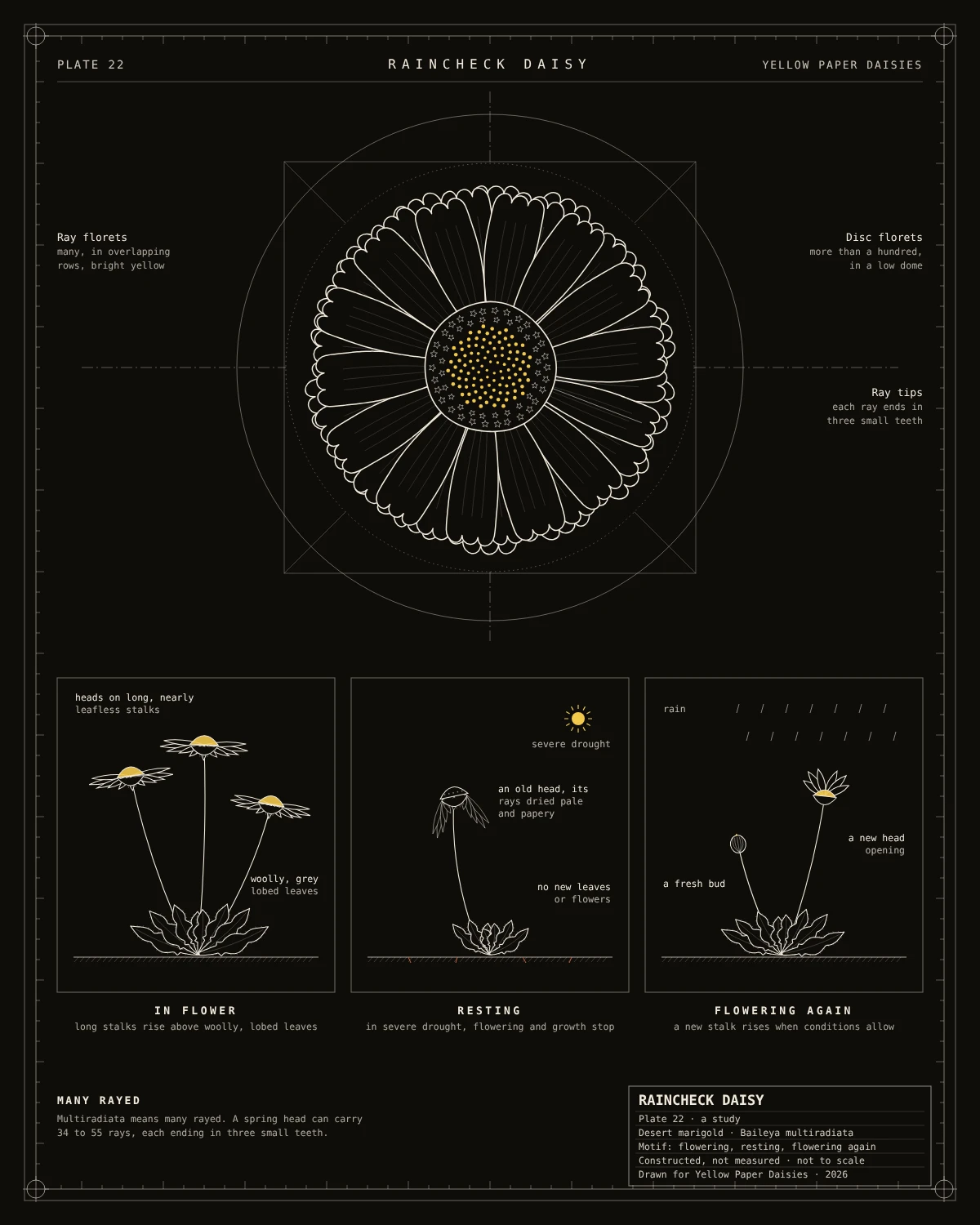

This is the third and final idea in a series inspired by Plato’s Allegory of the Cave. Kosmos Daisy explored the people problem: the human roles AI governance needs. Compass Daisy explored the technology problem: the tools those people need. RainCheck Daisy completes the series by tackling the process problem: how people and tools work together to govern AI over time.
Context & Motivation
In Plato's Allegory of the Cave, people held since childhood facing a cave wall take the shadows cast on it for the world itself, until one is freed and turns toward the light [A]. If the Allegory of the Cave teaches us that education is the process of turning away from shadows to look at reality, then AI governance is the process of building the machinery that makes that turn possible.
Kosmos Daisy named the people AI governance needs, and Compass Daisy proposed their tools. What remains is figuring out how people and tools work together over time. Plato’s freed human could not face the sun all at once. He learned to see in stages. AI should follow a similar path, earning authority over real world implications gradually. But who decides when it is ready, and how much authority it should have? The humans never chose to live in the cave. Today, people can be affected by AI decisions without ever choosing to use AI themselves. How do we give them a say before AI acts on their lives? And when the human returns to the cave, no one believes him. When an AI system goes wrong, the people who notice can be ignored, too. How do we take that authority away, and make sure warnings are heard?
AI agents now act rather than only answer. They book payments, screen applications and decide cases, often for people who never chose to use AI. Yet an agent can still move from a successful demonstration to real authority in a single step, and once there it rarely has to earn its place again.
Other fields have learned to build trust in stages. Medicines go through clinical trials and continue to be monitored after approval [B]. Pilots can report mistakes through a confidential system [C] and regularly practise flying without automation [D]. AI agents, by contrast, can move from a successful demonstration to real-world authority with little in between.
AI needs the same kind of loop. Authority is granted in stages, watched closely, paused when risks emerge and returned only when trust is restored.
Target Audience
Public services and companies deploying AI agents need a clear path to grant them authority without betting everything on a single decision. The people who approve and oversee AI agents, such as the AI Stewards proposed in Kosmos Daisy, need shared stages and evidence so that approval means the same thing across organizations. Policymakers and civil society need ways to represent people affected by AI, including those who never use it. Future generations need a record of what we decided, why we decided it and what we learned.
Customer Problems
Imagine a city's benefits office introduces an AI agent to screen applications. After passing a demonstration, it begins deciding thousands of cases within weeks. Many residents are never told that AI is involved, let alone asked how they feel about it. Caseworkers gradually stop processing applications themselves.
Months later, a serious error forces the city to pause the agent. Staff can no longer handle the workload at its previous pace, and no one has a reliable picture of how residents were affected before the change. The city has no agreed process for restoring the agent's authority or rebuilding public trust.
Across thousands of services, the same problem emerges: AI gains authority without clear stages, meaningful consent or a defined path back when things go wrong. Meanwhile, the reasoning and assumptions behind important decisions can disappear.
Hypothesis
- Unseen by the cave: People affected by AI, including those who never use it, are rarely informed, consulted or included in efforts to measure how their lives have changed.
- Authority in one step: Passing a test can be treated as permission to deploy, leaving AI agents with real authority before they have earned it through staged use and review.
- Truth without review: There are few established processes for revisiting what AI has been taught as facts, or for ensuring that serious findings reach people who can act on them.
- Benefit without a mandate: Builders often define what counts as beneficial, while the people responsible for oversight are rarely rotated or held accountable for whether their work makes a difference.
- No return: Dissent can go unanswered, people lose the skills needed to take back control, and future decision-makers inherit systems without a clear record of why they were approved.
Solutions
- Consent of the cave: Libraries and statistics agencies maintain dated, consent-based records of how people think, learn and make decisions today, revisited through annual studies. Before AI agents make decisions affecting residents, public services hold consultation periods and explain when AI has shaped an individual decision [E]. National surveys include people who do not use AI, giving them a voice in how it changes society.
- Earning the reins: Testing an AI agent and granting it permission to operate are separate decisions. Agents earn authority through four stages: a sandbox, a supervised pilot, a limited release and a wider release. Each approval records the responsible person, the permitted scope and an expiry date. If an agent is paused, it must work through the stages again before regaining authority. When agents with conflicting permissions disagree, the one with less authority must defer to a human decision-maker.
- Reviewing the fire: Claims taught to AI come with review dates. When they expire, they must be checked again or removed from use. Serious findings raised by either people or AI go through protected reporting channels to an independent body, making it harder for inconvenient evidence to be quietly dismissed.
- Governing in turns: Rotating citizens' panels help define what public benefit means, while a public map shows where AI is permitted to make decisions, assist people or remain out of the process in each sector. AI Stewards serve fixed terms with cooling-off periods, drawing on the principle of auditor rotation [F]. Their work is also evaluated to establish whether oversight actually changes decisions or outcomes.
- The return and the record: Teams continue performing a portion of critical work without AI, much as pilots practise flying manually. People who challenge important findings receive written responses, and incidents are reported without blame so others can learn from them. Approvals include dated predictions about expected outcomes, which are later reviewed and renewed. The reasoning, assumptions and dissent behind major AI decisions are preserved in national archives, drawing inspiration from efforts to warn future generations about nuclear waste repositories over ten thousand years [G].
Outcome
- Trust in AI is earned through visible stages of testing, approval and ongoing review.
- People have a voice in how AI shapes their lives, even when they never chose to use it.
- Humans retain the knowledge and skills needed to take back control when necessary.
- Governing AI becomes a shared public responsibility, exercised in turns rather than held as a private privilege.
- Future generations can understand what AI changed, what we believed at the time and why we made the choices we did.
Appendix
- Plato, Republic, Book VII, 514a–521b, on the cave, the gradual ascent towards understanding, the return and the duty to govern in turns. Read the text
- US Food and Drug Administration, the drug development process, from clinical trial phases to post-market safety monitoring. Read the overview
- Aviation Safety Reporting System, established in April 1976 and operated by NASA, with conditional immunity for reporters. Read the overview
- US Federal Aviation Administration, Safety Alert for Operators 13002 (2013), recommending regular manual flight to help pilots maintain their skills. Read the alert
- EU AI Act, Article 50, covering disclosure of certain AI interactions and the marking of AI-generated content. Read the article
- Summary of the Sarbanes-Oxley Act, Title II, on auditor independence and partner rotation. Read the summary
- US Department of Energy, plans for warning future generations about a nuclear waste repository over a period of ten thousand years. Read the plan