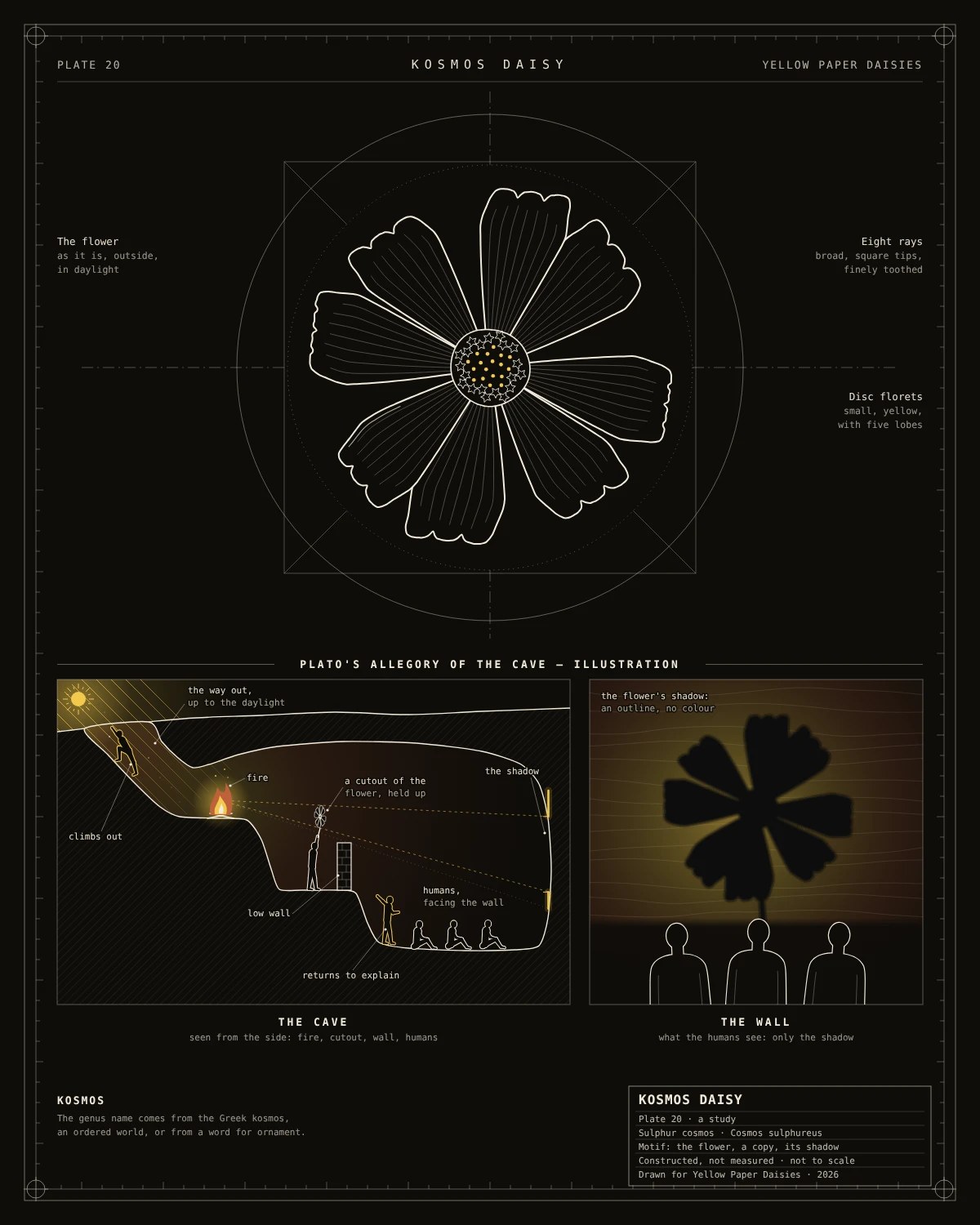

This idea is the first in a three-part series inspired by Plato's Allegory of the Cave. This idea explores people problem, the human roles AI governance needs. Compass Daisy extends it to the technology problem, the tools those people need to do their work. The third part will cover process.
Context & Motivation
For most of history, a machine that could talk, reason and act belonged to fiction. When one arrived, it startled humanity. Suddenly it seemed we could build almost anything, and everyone rushed to try. In that rush to build and stay ahead, one question received less attention than it deserved. What is truly worth building with this technology, and how? Answering it takes philosophy, the meticulously deep thinking that tells us what is worth doing. And philosophy has an old story for moments like this.
In Plato's Allegory of the Cave, he hypothesizes a story of humans who have spent their entire lives facing a blank stone wall [A]. Behind them burns a fire, and in front of that fire, people carry puppet-like figures, casting dancing shadows onto the wall. Having never seen the true objects themselves, the prisoners mistake these shadows for absolute reality. When one prisoner is finally freed and forced to climb toward the surface, the glaring sunlight initially blinds him. He must learn to see in stages until he discovers the sun and the true world outside. Upon returning to the cave to free the others, his eyes struggle to readjust to the darkness. The remaining prisoners, believing the journey has ruined his sight, mock him and resist being led out. Plato used this story to illustrate that education is not simply pouring facts into an empty mind. Rather, it is the difficult and often disorienting process of turning our perspective away from comfortable illusions and toward the light, in search of deeper answers.
Now place AI in that same cave. For years it watched and listened to us and learned to probabilistically predict the next shadow. It came to analyze the shadows and understand our world as the cave shows it, until it became the most expert shadow analyst the cave has known. Today we are also handing AI agents the puppets (control over our reality as we know it). What they move does more than cast shadows on the wall. It shapes real decisions in our daily lives.
This is why we turn to Plato today. Our goal is to bring some 'order', or kosmos, to the cave we now share with AI, so that humanity can prosper. Order needs governance. Governance requires accountability, and accountability requires people with defined roles. Earlier technologies found theirs. Railways brought inspectors [B], cars brought driving examiners [C] and computing brought data protection officers [D]. AI is still waiting for its own. These are the missing human links.
Target Audience
Banks, hospitals, employers and public services that want accountable people with clearly defined roles behind every AI decision, so they can use AI lawfully and keep the trust of the people they serve. The largest companies running AI agents that want guardrails built from people, not just code, so their agents can grow safely. Insurers and regulators that want a named person behind each high stakes use, so they can price risk fairly and enforce rules with confidence. Humans who care about the future of humanity, and the effects AI might have on future generations.
Customer Problems
Humans still have important work in this cave. Someone must make sure AI reads the shadows correctly and keeps improving as language models grow better and faster. Someone must tend the fire and decide what AI should learn as true. Someone must stage new shadow plays, the experiments that explore the full solution space, from today's most pressing problems to curing cancer. Someone must let AI agents learn their craft where mistakes cost no one, and decide what AI may do before it takes the reins. Only then can we hand it the puppets of our daily reality with care, so humans are free to walk outside toward higher order work. And someone must design a resilient society to keep watch over what follows, for years and generations to come.
Today much of this work is spread loosely across teams, and some of it is not yet anyone's job. Who is building these roles for today and tomorrow? More importantly, who is teaching the skills this future workforce will need? The problem then is that the human functions governance depends on do not yet have clear owners, so when something goes wrong, accountability is unclear.
Hypothesis
- Reading the shadows: We mostly check AI's answers, and less often the assumptions behind them or how it reached them.
- Tending the fire: We rarely decide openly what AI should learn as true, or whether a truth will last or is only in fashion. We also rarely ask whether something true for us should also be true for AI.
- Staging the shadow plays: Deeper questions that AI cannot answer often go unexplored instead of becoming research.
- Holding the puppets: AI agents learn their craft alongside real people in one large experiment. Has adequate effort been allocated to study its large scale social consequences and epistemology?
- Handing AI the puppets: AI agents have tremendous authority over people's lives. Has adequate effort been allocated to stepping back and deciding whether we want this, and what the right approach is?
- Walking outside: Few people are paid to question the assumptions AI is built on.
- Keeping the long view: Predictions about AI's effects on society are seldom recorded or checked later.
Solutions
- Shadow Reader: One human should ensure that AI is reading shadows (our world as we know it) accurately and is improving and getting faster at it. Shadow here means reality as we know it through language. Today this role is being played by model evaluators, red teamers and benchmark builders. The world needs more philosophers of science who check the assumptions behind AI's answers. This human is accountable for one question. Is AI reading reality correctly?
- Truth Seeker: One human should tend the fire that casts the shadows, deciding what AI is taught as knowledge, how sure it should be, and whether a truth will last or is only in fashion. Today this role is being played by data curation teams, model specification writers and academic philosophers. The world needs more epistemologists who weigh the evidence behind what AI learns and judge whether it is worth teaching. This human is accountable for one question. What should AI learn as true, and how do we know?
- Shadow Play Director One human should stage new shadow plays until today's problems are solved, asking why the shadow does not move in other ways. Today this role is being played by AI for science teams and research program managers. The world needs more research designers who turn the questions AI cannot answer into funded studies. This human is accountable for one question. What does AI still not know, and how do we find out?
- Sandboxer: One human should make sure AI agents learn their craft in a sandbox cave where mistakes cost no one, and study their effects on people and on how we come to know things before agents move into the real world. Today this role is being played by red teamers and capability evaluators who test models before release. The world needs more security and evaluation experts who study an agent's effects, grant it authority in stages and take it back when needed. This human is accountable for one question. What is this agent doing to people, and does it have more authority than it needs?
- AI Steward: One human should step back before AI is handed the puppets and decide whether we want this, and what the right approach is. Today this role is being played by chief AI officers, governance teams and overseers named under new laws. The world needs more licensed overseers with domain and ethics training, independent and protected when declining. This human is accountable for one question. Should AI make this decision at all, and if so, how?
- Daylight Fellow: One human should walk outside the cave, freed by agents from routine work, to explore what neither AI nor humans have seen. Today this role is being played by a few philosophers in AI labs and long term research fellows. The world needs more philosophers and scientists who are paid to question the assumptions AI is built on and have a voice in boardrooms. This human is accountable for one question. What are we not seeing? If we're seeing the right things, are we seeing them for the right reasons?
- Horizon Registrar: One human should watch and predict what teaching AI does to society over years, decades and centuries, with predictions less certain the further ahead they look. Today this role is being played by forecasters, foresight units and archivists. The world needs more forecasters who tie dated predictions to specific AI decisions and check them. This human is accountable for one question. Were we right, and what did we assume?
Outcome
- The human functions of AI governance become recognized roles with clear owners, as inspectors and examiners did for railways and cars.
- Whenever AI has a consequential effects on society, a person can explain the decision and answer for it.
- Universities and employers train people for these roles, opening new careers as AI takes on routine work.
- Philosophers and scientists regain a seat where decisions about AI are made.
- Humans redesign the brave new world to work on questions that are truly worth answering, and the role of humans in exploring those answers.
Appendix
- Plato, Republic, Book VII. Read the text
- Railway inspectors in Britain, appointed from 1840. Read the history
- Britain's compulsory driving test, from 1935. Read the history
- The data protection officer's protections under EU law. Read the article